Jason Crowder–Father Patterson relationship
Exorcist FallsJason Crowder’s relationship with Father Patterson becomes an unexpected mentor-pupil bond, formed in the aftermath of Father Sutherland’s death and tested by the murders surrounding Casey Hartman. Patterson offers Crowder care, approval, and moral counsel when Crowder is isolated by guilt and uncertainty. But the trust they build is brutally unsettled when Malephar takes Patterson as a host, transforming a source of spiritual guidance into a threat.
A New Pastoral Alliance
Crowder’s connection with Father Patterson takes shape against the loss of Father Sutherland, whom Crowder regards as Patterson’s best friend. After Sutherland’s death, Crowder doubts that he could enjoy the same kind of mentor-pupil relationship again. His later realization that he and Patterson may be establishing precisely that dynamic makes the connection feel both new and shadowed by bereavement: Patterson is not simply a replacement, but a priest with whom Crowder comes to understand one another better.
The relationship is grounded in difficult questions about how to respond to Casey Hartman. Earlier, Crowder tries to address the family’s fear without prematurely deciding whether Casey’s condition has a supernatural or psychological cause. He stresses that he has not yet examined the boy and that potential causes must be investigated. This careful stance provides important context for Crowder’s later work with other priests: the question of what Casey is experiencing carries consequences for both his treatment and his family.
Care in the Midst of Danger
Patterson’s practical care for Crowder becomes visible when Crowder is badly wounded. Sister Rebecca examines him in Patterson’s office, removing a dripping scarlet towel from his injuries and asking why Patterson did not call an ambulance. Patterson answers that discretion was necessary because the wounds would be difficult to explain. His choice places the immediate handling of Crowder’s condition in the hands of people who know the circumstances, rather than medical responders who might see an inexplicable injury without its context.
After the confrontation at the reservoir, Patterson accompanies Crowder in an ambulance to the hospital. It is Crowder’s second hospital visit in a week. A doctor named Kim finds that the wound in Crowder’s side looks as though it was inflicted a month earlier and has mostly healed. Crowder recognizes how unusual that appearance is and feels, briefly, grateful to Malephar for the healing. The episode nevertheless emphasizes Patterson’s closeness to him: after a dangerous encounter, Patterson is physically present and rides with him to receive care.
Approval and Moral Counsel
The clearest expression of their emerging bond comes when Crowder visits Patterson’s office after a church service. The room is lit by candles on the desk and end tables; the welcoming atmosphere and Patterson’s warm manner ease Crowder’s nerves. Patterson invites him to sit and reports that Sister Rebecca said the service went well. Crowder takes evident pleasure in receiving his approval, a response that confirms how much Patterson’s judgment has come to matter to him.
Patterson asks whether Crowder was nervous, and Crowder admits that he was, while crediting thorough preparation with helping him through it. Patterson tells him he is proud of him. For Crowder, who has not expected to find another mentor after Sutherland’s death, the praise is more than courtesy: it makes the possibility of a new guiding relationship concrete. The warmth does not erase Crowder’s shock about Casey, but it offers some relief within an ordeal that has left him longing for a friendly face.
That trust also makes Patterson’s counsel consequential. When Crowder says Tyler Raines did not kill anyone, Patterson asks why Danny Hartman would have killed him. Crowder answers that Danny knew Tyler had uncovered his secret and killed him to protect himself. Patterson then asks who killed Julia Deveroux if Raines was not responsible. The exchange presses Crowder to account for the unresolved murders rather than accept an explanation that leaves their central crime unanswered.
Patterson’s clearest moral demand comes when Crowder weighs turning Casey in to the authorities against breaking Liz Hartman’s heart. Patterson argues that Liz must be allowed to begin healing if doing so means there will be no more dead children. Crowder agrees that Patterson is right. The advice bears directly on Crowder’s own exposure: he expects Casey to reveal that Crowder killed Father Sutherland, and he believes he would have to tell the authorities that the killing was an error and face a long imprisonment. He considers confessing this truth to Patterson, recognizing that Patterson might despise him for killing his best friend but might also respect the confession. The relationship has reached a point where Crowder imagines bringing his deepest guilt to Patterson as a priest and trusted guide.
Trust Reversed
Crowder does not confess before Patterson mentions that Sister Rebecca has taken a liking to him and admits that he himself has sometimes felt attracted to her. Crowder is surprised by the disclosure, which reveals a more personal side of Patterson just as Crowder is preparing to bare his own secret. The moment briefly redirects the conversation from Crowder’s guilt to Patterson’s feelings, leaving the intended confession unspoken.
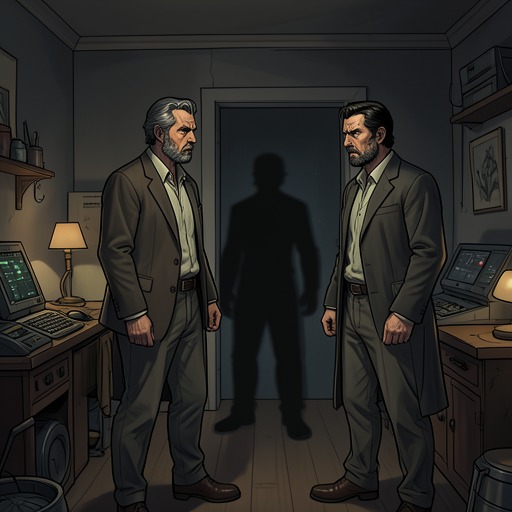
The apparent intimacy of the office scene is later exposed as dangerous. A figure using Patterson’s face addresses Crowder not by name but as Craven, then explains that Patterson arrived at a fortunate moment and makes the perfect host. The voice identifies itself through the explanation that Crowder killed one of its servants; its red-glowing eyes confirm the threat as Malephar’s. The revelation overturns the meaning of the familiar priestly presence: Patterson is no longer speaking as Crowder’s mentor but has become the vessel through which the demon confronts him.
The reversal does not erase the care and approval Crowder previously received, but it makes their new bond precarious. Patterson had accompanied Crowder to the hospital, welcomed him into a candlelit office, praised his service, and urged him to protect lives even when the truth would wound a family. Malephar’s possession turns that trusted presence into an instrument of intimidation, leaving Crowder to face the collapse of a relationship he had only just begun to hope could continue the guidance he lost with Father Sutherland.